
How to Troubleshoot Your Own Tech

For most of us, our default tech support strategy is to turn the device off, turn it back on, and hope for the best. And, honestly, that works more often than it should.
But what happens when it doesn’t do the trick? What do you do when your Wi-Fi is still sluggish, your app is still frozen, or your smart thermostat blinks on the coldest or hottest day of the year?
That’s where this guide comes in. The average U.S. household now runs on 21 connected devices, of all varieties. When any one of them acts up, your smart home can outwit you.
The good news is that most tech problems have simple fixes that don’t require technical training. This guide walks you through what to try, in what order, and when it’s time to stop troubleshooting and call in an expert.
H2: Key Takeaways
- Simply restarting the malfunctioning device clears temporary memory and fixes more issues than most people expect. It’s the easiest and most effective first step.
- Testing on a second device is the fastest way to figure out if a problem is device-specific or network-wide.
- Software updates resolve a surprising number of bugs, crashes, and connectivity failures.
- Most common tech problems — slow Wi-Fi, frozen apps, disconnected smart devices — can be fixed in under 10 minutes.
- Knowing when to stop and ask for help is part of good troubleshooting, not a sign of defeat.
- EarthLink EasyTech offers on-demand remote support for any device in your home, with no appointment needed.
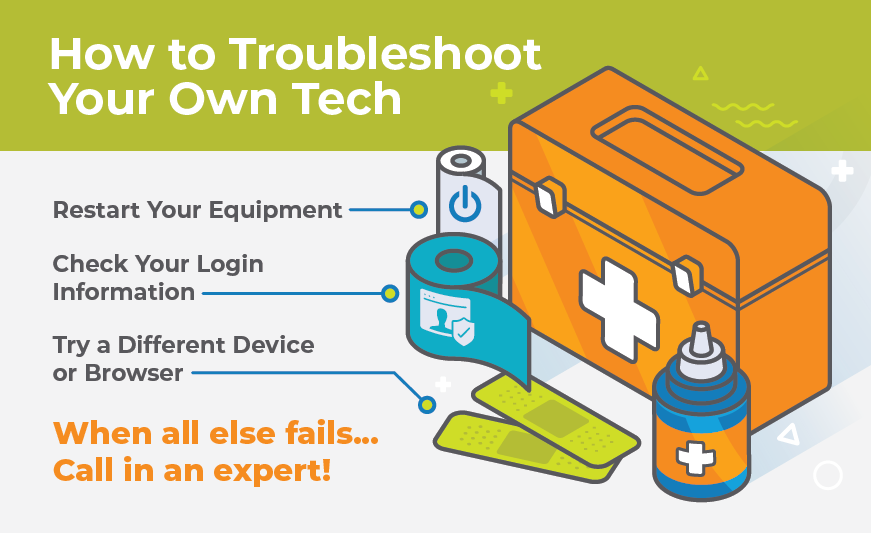
What to Try First When Your Tech Stops Working
Before you start swapping out cables or Googling obscure error codes, try these eight steps. They cover the most common causes of tech problems and work on almost every type of device, from smartphones and laptops to routers and smart home gadgets.
Work through them in order since the first several tips often solve the problem.
- Restart the device. Power it off, not just sleep mode or lock screen. Wait 30 seconds, then turn it back on. This clears the device’s temporary memory and resolves most software-related issues.
- Check the basics. Verify that power cables are plugged in, that your Wi-Fi is turned on, and that the device is connected to the network. It sounds almost too simple, but a loose cable or an accidentally toggled setting is responsible for more “tech problems” than most people would expect.
- Check for software updates. Outdated software is one of the most common causes of app crashes, connectivity failures, and slow performance. Before you do anything else, check whether an update is available for the operating system or the app that’s causing the issue. Many bugs are patched before you even realize there was a problem.
- Clear the cache. Cached data builds over time and can cause sluggish performance, loading errors, and unexpected behavior. Clearing it on your browser or app is quick, safe, and often fixes problems that seem unrelated to storage.
- Test a second device. Open the same app or website on a different phone, tablet, or laptop. If you can’t replicate the issue on the second device, it’s specific to your original device. But if you can, then the problem is more likely with your network or the service itself.
- Try a different browser. If a website won’t load in Chrome, try Firefox or Edge. If it works there, the issue is browser specific. It’s usually a cache problem, a conflicting extension, or outdated browser settings. Clear the original browser’s data and try again.
- Research the error message. If you’re seeing an error code, drop it into Google. Manufacturers usually have well-documented fixes.
- Use a password manager. If you’re having login issues, use a reputable password manager to keep your logins and passwords organized and secure across all your devices.
How Do You Fix a Slow or Dropped Wi-Fi Connection?
Slow or unreliable Wi-Fi is the number one tech complaint in American homes. Before you call your ISP or assume the worst, there’s a good chance one of these steps will get things moving again.
- Restart your router and modem. Unplug both from the wall, wait 30 seconds, then plug the modem back in first. Wait for it to fully reconnect, then plug in the router. This sequence matters. Give the router a full minute before testing your connection; it needs time to re-establish contact with your ISP.
- Check your router placement. Routers work best in a central, elevated location with as few walls as possible between them and your devices. Thick walls, microwaves, and other electronics can all degrade your signal. Don’t keep your router tucked away in a cabinet or closet. Keep it as unobstructed as possible and in a central location in your home for the best coverage.
- Disconnect devices you aren’t using. Every device on your network uses a slice of available bandwidth. Streaming, gaming, and video calls are especially heavy. If six devices are pulling data and your connection is struggling, start by disconnecting the ones you don’t need right now.
- Run an internet speed test. Run an internet speed test at TestMySpeed and compare your actual results against the speeds listed in your internet plan. If your test results are significantly slower than what you’re paying for, that’s worth a call to your ISP. If the speeds are normal, the problem is more likely due to the device or app.
- Check for outages in your area. Before spending an hour troubleshooting hardware, check your ISP’s website or app for any known outages. If there’s a service disruption in your area, no amount of rebooting on your end will fix it — the issue is upstream, and the fix has to come from the ISP.
Time to call for help? Look for these signs:
- Your speed test consistently shows results far below your plan, even after restarting all equipment.
- Wi-Fi drops at the same time each day (this can signal interference or ISP-side issues).
- No devices in your home can connect, and there’s no confirmed outage.
EasyTech Tip: If your Wi-Fi is still struggling after working through these steps, EarthLink EasyTech can remotely diagnose connection issues across your devices without waiting for a tech visit.
What to Do When an App or Program Freezes
A frozen app is frustrating, but it’s almost always fixable without a trip to the repair shop. Here’s how to handle it cleanly.
- Force-quit the app. In Windows: Press Ctrl + Alt + Delete, open Task Manager, select the frozen app, and then click End Task. On a Mac: Press Command + Option + Escape, select the app, and then click Force Quit. On iPhone or Android: Swipe the app closed from the Recent Apps screen. Then wait a few seconds before reopening it.
- Check for updates before reopening. Many crashes are caused by bugs that have already been patched. Before you reopen the app, check for an update. On mobile, look in the App Store or Google Play. On desktop, check the app’s Help or About menu for an update option.
- Clear the app’s cache. On Android: Go to Settings, find the app under Apps, and tap Clear Cache. In a browser: head to Settings, find Privacy or History, and clear browsing data. This removes stored temporary files that can cause erratic behavior, without deleting your account data.
- Uninstall and reinstall. If the app keeps crashing after a cache clear and an update check, a clean reinstall often does the job. This replaces any corrupted files a standard update might miss.
Time to call for help? Look for these signs:
- Multiple apps are crashing at the same time, which points to a system-level issue, like low RAM, storage problems, or OS corruption.
- The issue persists after reinstalling a fully updated operating system.
- The device is running noticeably hot alongside the crashes, which can signal a hardware problem.
[H2] How Do You Troubleshoot a Smart Home Device That Won’t Connect?
Smart home devices are everywhere. 63% of U.S. households now own at least one, and 26% of those owners say connectivity issues are their biggest frustration. And it makes sense, as many of these devices provide convenience and automation. Most of the time, though, issues with smart devices are fixable. Try these steps before giving up on the device.
- Confirm your Wi-Fi is actually working. Test your internet connection on a different device, like your phone or laptop. If the problem is your Wi-Fi itself, fix that first — a smart device can’t connect to a network that isn’t running.
- Restart the smart device. Most smart devices have a physical button to power them off, or a restart option in their companion app. Power-cycling the device forces it to re-establish a fresh connection to your network. Give it a full minute before checking the app.
- Check for firmware updates. Open the device’s companion app and look in Settings for available firmware updates. Bugs are frequently patched in updates, and you can set up automatic updates through the app.
- Remove the device and re-add it. In the companion app, delete the device from your account entirely and go through the initial setup again, as if it’s brand new. This resets its network credentials and resolves most persistent connection issues.
- Check Wi-Fi band compatibility. This one trips up a lot of people. Many smart home devices, like smart bulbs, thermostats, doorbells, only support 2.4 GHz Wi-Fi, not 5 GHz. If your router broadcasts both bands under the same network name, the device may be trying to connect to the 5GHz band but failing. Try separating the two bands in your router settings and connecting the device specifically to the 2.4GHz band.
Time to call for help? Look for these signs:
- The device still won’t connect after a full reset and setup.
- The app shows the device as online, but it doesn’t respond to any commands.
- Multiple smart devices drop connectivity at the same time, which usually points to a router or ISP issue rather than the devices themselves.
Sources: SQ Magazine, Smart Home Statistics 2025. American Home Shield, Smart Home Survey, December 2024.
[H2] What Do You Do If Your Computer Won’t Turn On?
A computer that won’t power on can feel like a catastrophe. Before you panic, know that many of the most common causes are far simpler than they look.
- Verify the power source first. Plug a different device, like a phone charger or a lamp, into the same outlet to confirm the outlet is actually working. It happens more than you’d think. Also, check that the power cable is seated firmly in the outlet and in the computer.
- Remove external peripherals. Unplug USB drives, external hard drives, monitors, docking stations, and any other accessories. A faulty peripheral can occasionally prevent a computer from completing the startup sequence. Unplug everything, then try powering on again.
- Attempt a hard reset. Hold the power button down for 10 to 15 seconds until the computer shuts off completely. Wait a moment, then press it once to restart normally. On laptops with a removable battery, take it out, wait 30 seconds, reinsert it, then try again.
- Listen and look for diagnostic signals. Pay attention to what the computer does when you press the power button. Fan spin, beep codes, and blinking LED lights are all diagnostic signals. Look up your specific beep pattern or LED sequence alongside your device model. Manufacturers publish these, and they point directly to the cause.
Time to call for help? Look for these signs:
- No lights, no sounds, no fan spin…nothing…after confirming the outlet works and completing a hard reset.
- You hear clicking sounds coming from the device. That can indicate a failing hard drive and continuing to use the device risks data loss.
- The computer powers on briefly and shuts itself off repeatedly before loading the operating system.
Note: If you suspect a failing hard drive, stop using the device and contact a professional as soon as possible. The less the drive spins, the better your chances of data recovery.
[H2] How to Fix Tech Problems Caused by Outdated Software
Software updates aren’t just about adding new features. They include security patches, bug fixes, and compatibility improvements that affect how your devices run. Stay up to date with software patches. They’re one of the most common reasons tech problems linger longer than they should.
- Update your operating system. On Windows: Start > Settings > Windows Update. On Mac: Apple menu > System Settings > General > Software Update. Let it run and don’t interrupt it.
- Update individual apps. On mobile, open the App Store (iOS) or Google Play (Android) and check for pending updates. On desktop, look in the app’s Help or About menu for a “Check for Updates” option. Do this especially for the app that’s giving you trouble.
- Restart after updating. This is the step a lot of people skip. Many updates won’t apply until the device restarts.
- Turn on automatic updates. Once you’re current, enable automatic updates, so future fixes apply without you having to think about it. Most devices support this in Settings > System or Software > Automatic Updates.
Quick Troubleshooting Tips: Common Problems and What to Try First
Not sure where to start? Use this quick reference to find the right first step for your specific issue.
| Problem or Symptom | First Step to Try | Call EasyTech If… |
| Slow or dropped Wi-Fi | Restart your router (unplug 30 sec, replug) | Speeds remain low after restarting; ISP outage suspected |
| Frozen app or program | Force-quit and reopen the app | Multiple apps keep crashing after reinstalling |
| Device won’t turn on | Check power cable and outlet; try hard reset | No response after confirmed power and hard reset |
| Smart home device offline | Restart device and router; re-add in the app | Device still won’t connect after firmware update |
| Slow computer | Restart; close background apps; clear cache | Persistent sluggishness with unusual sounds or error screens |
| Bluetooth won’t connect | Toggle Bluetooth off and back on; forget and re-pair | No devices detected after re-pairing on multiple devices |
| Printer not responding | Check Wi-Fi; update driver; restart printer | Persistent errors after driver reinstall |
| Website or app won’t load | Test on a second device or a different browser | All devices affected may be an ISP issue; contact EarthLink |
When Is It Time to Stop Troubleshooting and Call a Tech?
It’s frustrating to go through all these troubleshooting steps to no avail, only to feel compelled to try again. But knowing when to stop is part of good troubleshooting; sometimes, doing too much troubleshooting can cause other issues. So, when you’ve reached the end of these tips without a resolution, it’s time to hand it over to a tech.
Here are the clearest signs that it’s time to hand it off to someone who does this for a living.
- You’ve restarted, updated, and reinstalled at least two or three times without any improvement.
- The device is making unusual sounds, like clicking, grinding, or buzzing, especially in hard drives and laptops.
- You’re seeing a recurring Blue Screen of Death on Windows or a kernel panic on Mac.
- There’s visible physical damage: cracked or bent ports, exposed wiring, and burn marks.
- The device holds important data, and you’re worried about making the situation worse.
- Multiple devices failing at the same time, which can point to a network or power issue rather than a device issue.
- You’ve moved from educated troubleshooting to random guessing. That’s when it’s time.
How to Escalate Your Issue
- Contact the device manufacturer. If the device is still under warranty, the manufacturer may repair or replace it at no cost. Check your warranty status before paying for a repair.
- Check the warranty coverage on the device, service, or app. Even out-of-warranty repairs sometimes qualify for the manufacturer’s flat-rate service programs. It’s worth a five-minute check.
- Call EarthLink EasyTech. EasyTech connects you directly with on-demand tech experts who can remotely access your device and walk you through a fix or handle it themselves. It covers an unlimited number of devices (not just your internet connection), including everything from your laptop to your smart fridge to your voice-enabled speakers. No appointment. No waiting room. You’ll connect through the EasyTech app, and your agent can see exactly what’s happening on the device in real time.
You’ve Got This: Most Tech Problems Are Fixable
Tech problems can seem monumental and often happen at the most inconvenient time. During an important work call, during a competitive online gaming match, or halfway through a Netflix marathon. But more often than not, slow Wi-Fi, frozen apps, a smart device that’s gone quiet, and a glitchy computer follow predictable patterns and have easy fixes you can do quickly.
Before you assume the worst, work through the steps in this guide, start with the simplest, and let the process narrow down the cause. As our homes run on more connected devices, a little troubleshooting know-how goes a long way.
If the problem persists after trying the steps above, it’s not a failure; it’s a sign that it’s time to bring in a pro. EarthLink EasyTech connects you with on-demand tech experts who can remotely diagnose and resolve issues across any device in your home, no appointment needed. Sometimes the best troubleshooting move is knowing exactly when to make that call.
Frequently Asked Questions
What is the first step to troubleshoot a tech problem?
Always start by rebooting the affected device. A restart clears temporary memory and resolves most software-related issues without requiring any technical knowledge. After it has rebooted, restart your router if the problem involves internet connectivity. If these don’t resolve the problem, the next step is to check for available software updates.
How do I fix a slow or dropped Wi-Fi connection?
Start by restarting your router: unplug it, wait 30 seconds, then plug it back in. While it’s reconnecting, ensure the router is unobstructed and placed in a central location for the best coverage between the router and your devices. Disconnect any devices you aren’t using, then run an internet speed test to compare your real-world speed against your plan’s speed. If speeds are normal but specific devices are still struggling, the problem may be with the device rather than a network issue. Check your ISP’s app or website for known outages before assuming a hardware failure.
How do I force-close a frozen app?
On Windows, press Ctrl + Alt + Delete and open Task Manager. Select the frozen app and click End Task. On Mac, press Command + Option + Escape, select the app, and click Force Quit. On a smartphone, swipe the app closed from the Recent Apps screen. After force-closing, check for any available updates before reopening.
When should you stop troubleshooting tech and call a professional?
Call for help when you’ve restarted, updated, and reinstalled without improvement after two or three attempts. Other signs you need to escalate your issue are unusual device sounds (particularly clicking from hard drives), recurring error screens, visible physical damage, or any situation where important data might be at risk. EarthLink EasyTech provides on-demand remote support for unlimited devices, which saves you the time and hassle of taking your gear to a repair shop.
How do I troubleshoot a smart home device that won't connect?
First, confirm your Wi-Fi is working by testing on a different device. Restart the smart device using its physical button or companion app. In the companion app, check for firmware updates. Many connectivity issues are resolved in routine patches. If the device still won’t connect, remove it from the app and add it back as new to reset its network credentials. Also, verify that the device is compatible with your router’s Wi-Fi band: most smart home devices require a 2.4 GHz connection, not 5 GHz.
Can I fix most tech problems without calling tech support?
Yes, most common tech problems are solvable with basic steps: restart the device, check for updates, clear the cache, and test on a second device. Many manufacturers maintain a reliable knowledge base of error codes, causes, and fixes you can try before calling tech support. If you can’t find a solution there, a remote support service like EarthLink EasyTech is often faster and safer than continuing to troubleshoot on your own.